
New s. 26-105 of the ITAA 1997 — which denies a deduction for ‘non-compliant payments’ — was introduced by Schedule 1 of the Treasury Laws Amendment (Black Economy Taskforce Measures No. 2) Act 2018 (the Act), which received Royal Assent on 29 November 2018 as Act No. 141 of 2018. This legislative change implements recommendation 7.5 of the Black Economy Taskforce Final Report, and was intended to create a disincentive to businesses making payments to workers operating in the Black Economy.
Under the PAYG withholding system in Subdiv 12-B in Schedule 1 to the TAA, entities must withhold an amount from certain payments for work and services.
These relevantly include a payment:
Non-cash benefits
Division 14 of Schedule 1 to the TAA requires an entity to withhold from the provision of non-cash benefits in circumstances where an amount of withholding under s. 12 would have resulted if such a payment had been a payment of money.
A payer must pay an amount — calculated based on the market value of the benefit — to the Commissioner before providing the non-cash benefit.
Division 14 does not apply to the provision of fringe benefits, exempt fringe benefits and employee share schemes.
‘No ABN’ withholding
The ‘no ABN withholding’ rules (s. 12-190) require an entity to withhold, at the top marginal rate (47 per cent including the Medicare levy), from payments made to another entity where the other entity does not quote an ABN.
There are a number of exceptions, namely where:
Entities that are required to withhold must:
For payments to employees and contractors, the amount required to be withheld must be withheld at the time of making the payment (s. 16-5 of Schedule 1 to the TAA). The penalty for failing to withhold is 10 penalty units (i.e. $2,100).
Section 16-70 of Schedule 1 to the TAA requires an entity that is obliged to withhold an amount to pay that amount to the Commissioner in accordance with the rules in Subdiv 16-B of Schedule 1 to the TAA.
The rules for how and when amounts are to be paid vary depending on the status of the withholder:
| Withholder status | Criteria — amounts withheld for year | How and when withholding must be remitted to the Commissioner |
| Large s. 16-95 |
> $1 million (for the income year ending at least two months before the current month) |
Electronic payment is mandatory.
Depending on the day of the week on which the amount was withheld, payment required — within 6 to 8 days — on the first or second Monday or Thursday after the day of withholding (see s. 16-75(1)). |
| Medium s. 16-100 |
> $25,000 and ≤ $1 million (for the financial year ending before the current month) |
Electronic payment is required unless the Commissioner permits, in writing, some other method to be used.
Monthly on the 21st day after the end of each month (see s. 16-75(2)). |
| Small s. 16-105 |
Neither large nor medium | Electronic payment is required unless the Commissioner permits, in writing, some other method to be used.
Quarterly on the 21st day after the end of each quarter (see s. 16-75(3)). |
An entity that fails to pay PAYG withholding to the Commissioner by the time required will be liable to pay the general interest charge (GIC). The GIC will be levied on the unpaid amount for each day beginning on the day the payment was due to be paid and ending on the day when final payment is made of the unpaid amount or any general interest charge levied on the unpaid amount.
An entity that must remit amounts to the Commissioner must notify the Commissioner of the relevant amount on or before the day that the payment is required. The amounts are reported on an activity statement for the relevant period.
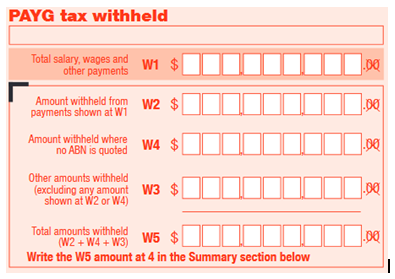
Penalties apply for not complying with the PAYG withholding obligations. Broadly, where a business fails to withhold a PAYG or no-ABN withholding amount, the penalty is equal to the amount that should have been withheld. There are also penalties for failing to lodge the required information under STP or through the required reports.
The latest measure which denies a tax deduction for non-compliant payments is an additional punitive measure to encourage taxpayers to comply with their withholding and reporting obligations.
A ‘non-compliant payment’ is a payment specified in s. 26-105(1)(a) to which the PAYG withholding regime applied, and the payer did not:
 Critical Points
Not all withholding payments fall under the new rules.
Only the following payments are affected:
 Definitions
The terms ‘goods’ and ‘real property’ take on their definitions in s. 195-1 of the GST Act:
There are three statutory exceptions to the non-deductibility rule.
A deduction is not denied if the amount required to be withheld — or the amount required to be paid to the Commissioner — is a nil amount (s. 26-105(4) of the ITAA 1997).
An employer that makes a payment or provides a non-cash benefit to an employee they believe to be a contractor is not denied a deduction if — had the employer been correct in characterising the employee as a contractor — the employer would not have been required to withhold (assuming the worker quoted their ABN).
If the misclassified worker did not quote an ABN and the employer failed to withhold, the deduction is denied.
The Explanatory Memorandum to the Act (para. 1.18) states that this exemption reflects the Government’s recognition that there are situations where an employer honestly believes their employees are contractors — and has complied with the no ABN withholding rule that would apply in that scenario — but this position is not upheld by the Commissioner.
This neatly side-steps the need to correctly classify the worker for the purpose of these rules. There may be other tax implications for mis-characterising a worker as a contractor instead of an employee, but the business won’t be denied a deduction under these measures if they failed to withhold and report PAYG withholding for that worker because they ‘honestly believed’ the worker was acting as a contractor.
 Note
Note
The requirement for an ‘honest belief’ that the worker is a contractor is only present in the Explanatory Memorandum to the Act and is not a criterion in the legislative provision, which broadly requires only that the payer has no reasonable grounds to believe that the worker does not have an ABN. The ATO will need to decide how it will administer those situations where it considers that the employer had deliberately misclassified the worker and entered into an arrangement for the employee to provide an ABN.
Warning
This exemption from the non-deductibility rule does not in any way affect any other consequences — for both the employer and the worker — of misclassifying the employee as a contractor.
|
Example — Incorrectly classified employee payments |
| Super Express Deliveries Pty Ltd carries on a business as a bicycle courier service. Super Express Deliveries engages around 30 bicycle couriers to enable it to fulfil orders from its customers.
Super Express Deliveries seeks legal advice about the engagement of the bicycle couriers. The advice concludes the bicycle couriers are independent contractors and are not employees. To this end, Super Express Deliveries requires each of its bicycle couriers to obtain an ABN and provide it to the company. Super Express Deliveries concludes that it did not have to withhold any amounts from the payments it made to couriers. The Commissioner conducts an audit of Super Express Deliveries and decides that the bicycle couriers are employees of Super Express Deliveries. After considering the Commissioner’s reasons and legal authorities, Super Express Deliveries does not dispute this conclusion and agrees to begin fulfilling its withholding obligations on this basis. The deduction available to Super Express Deliveries for its previous payments to bicycle couriers is not affected by its failure to withhold. Super Express Deliveries is still subject to penalties for its failure to withhold. Example 1.1 in the Explanatory Memorandum |
A deduction that would otherwise be denied is restored — in the original income year — if the employer voluntarily notifies the Commissioner of their mistake before the Commissioner tells the entity that an examination is to be made of its affairs relating to a taxation law (ss. 26-105(7) and (8) of the ITAA 1997).
Note
According to the Explanatory Memorandum to the Act (para. 1.22), this exemption is intended to encourage employers to come forward and comply with their withholding obligations.
|
Example — Voluntary notification |
| Caleb carries on a business as a mechanic. Caleb does not have any employees until he hires an apprentice, Bianca, in May 2020.
Caleb is not aware that he must withhold an amount from Bianca’s wages. Caleb visits his accountant in September 2020 to prepare his 2019–20 income tax return. He mentions his expenditure to pay Bianca’s wages. Caleb’s accountant advises Caleb he should have been withholding from the wage payments. Caleb notifies the Commissioner of his mistake. Caleb may still be subject to penalties for his failure to withhold. However, he is entitled to claim the deduction for the cost of Bianca’s wages in his 2019–20 income tax return. Example 1.2 in the Explanatory Memorandum |
ABOUT PBIS:
Pacific Business Integrated Solutions (PBIS), located in Hochiminh City, VietNam, is the most efficient and high quality SMSF, Accounting, Book-keeping & Financial Outsourcing operator serving the Australia market. Led by a professional management team experienced in Australia and the Asia-Pacific region, PBIS vision is aiming to provide the best value-for-money service in SMSFs, Taxation, Financial Planning to Accountants, Auditor, Financial Advisors, Accounting Advisory Firms in Australia.
PBIS has been among top Outsourcing providers of choice in terms of best quality services with fast turn-around time. Our Australian clients have been able to achieve significant up to 70% of HR/Admin cost and impressive growths through focusing on acquiring and taking care of customers.
Contact PBIS today to experience best practices in administration, privacy, compliance, real-time status tracking, and intelligent on-demand reports of business performance to scale up your business confidently.
Follow us on Social media for latest news and best service deals:
LinkedIn: https://www.linkedin.com/company/pbisoutsourcing/
Twitter: https://twitter.com/pbisoutsourcing
Facebook: https://www.facebook.com/pbisoutsourcing
Source: ATO
Division 296 has quickly become the central issue in the SMSF and superannuation...

Division 296 has quickly become the central issue in the SMSF and superannuation...
The Division 296 bill may have passed through Parliament but there are still a...

SMSFs are increasingly allocating their funds into cash and cash products as...